Against the background of higher electricity and gas prices before and after the beginning of the war in Ukraine in February 2022, the Austrian Federal Competition Authority (AFCA) and Energie-Control Austria (E-Control) launched a joint investigation into the Austrian energy sector (electricity and gas) in early 2023. The results of this investigation are now available in a final report.
Energy Task Force Final Report 2025 (in German)
Press conference material (in German)
Results of final report
All things considered, competition is not fully functioning in Austria 24 years after the market was liberalised. The market situation appears as follows:
- Market definition: The two authorities found that rather than competition across the country as a whole there is only local competition, and that a differentiation should be made between relevant customer groups (wholesale and retail). Market definition plays an important role in analysis and possible individual proceedings. It explains where competition is taking place.
- Market shares of providers: The providers dominate their network areas with market shares of between 68% and 98%.
- Foreclosure of network areas: A large number of providers, specifically those with extremely high market shares, offer electricity and gas only within their own respective network areas.
- Prices:
- Electricity prices vary considerably among geographical regions, meaning there is no homogenous national market.
- Usage-based prices (energy price only, excluding standing charges) for electricity and gas have dropped slightly since the two authorities started their investigation in early 2023. However, consumer prices have still not returned to pre-war levels.
- Consumer behaviour: Switching rates in Austria are particularly low compared with other European countries (50% of all customers have never switched providers), which increases providers’ market power. The switching rate for electricity is 4.5% and for gas 6%, while in Italy it is 18% and 13% respectively.
- Cross-holdings: The Austrian market is characterised by strong direct and indirect business links among energy suppliers. Such cross-holdings impede competition and impact negatively on Austria as a base for business.
“Market concentration continues to be very high. Local fragmentation, numerous cross-holdings among companies and low switching rates, when compared within the EU, characterise competition restrictions. We at the AFCA are now focusing on individual investigations,“ summarises Natalie Harsdorf, Director General of AFCA.
“Austrian switching rates are very low compared with the rest of Europe. In 2023, for example, those rates were 18% and 17% in Italy and Belgium respectively. There is still a lot of room for improvement here in Austria,” stresses Wolfgang Urbantschitsch, Executive Director of E-Control.
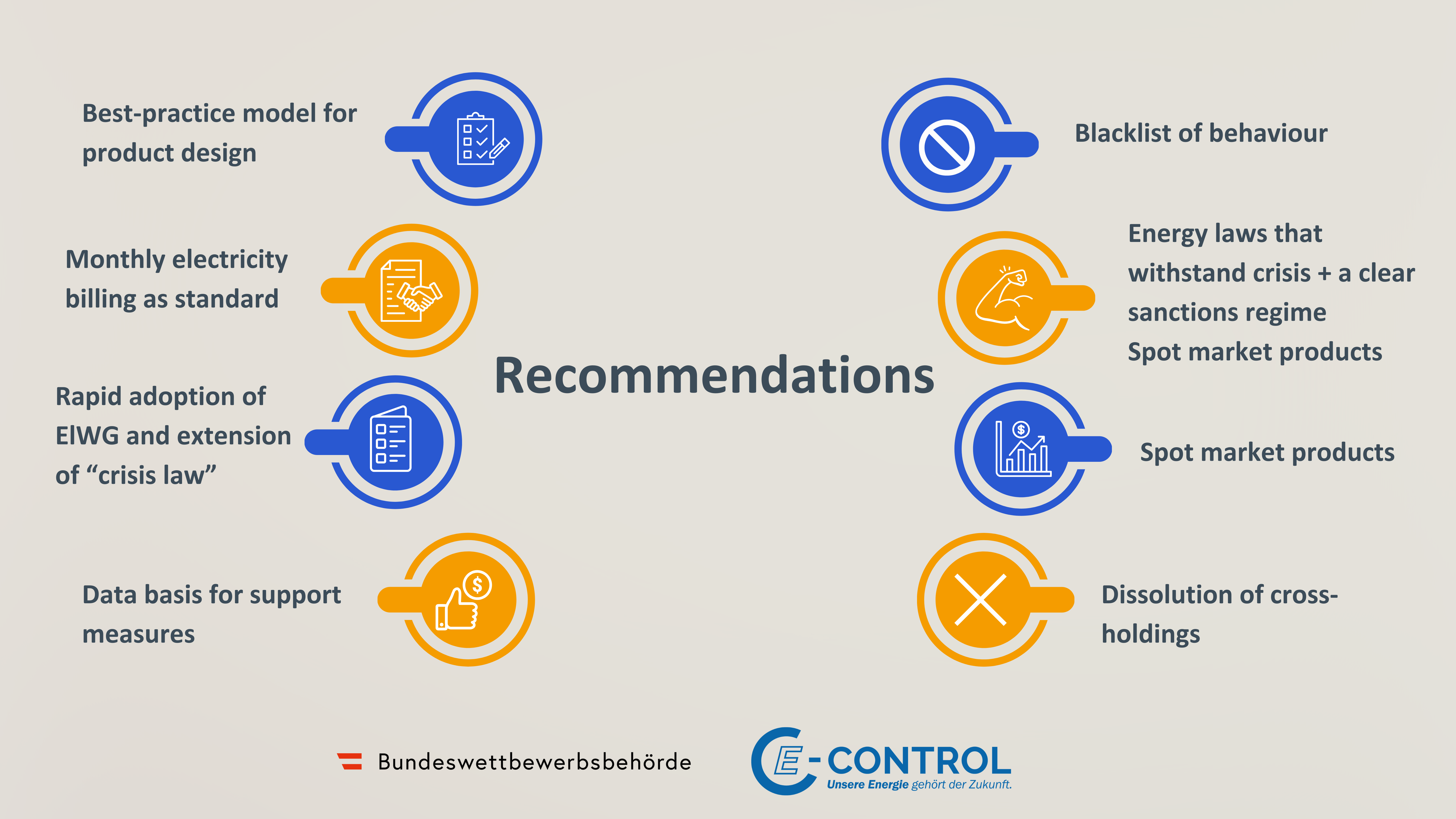
- A best-practice model for designing energy products should enable consumers to understand pricing better and select products transparently according to their needs. This will make it easier to compare products and gauge how prices are developing.
- Making monthly billing for electricity the standard means end customers get regular information about their actual costs. Smart meters have been rolled out in Austria, and available data should be used in the interests of customers and competition. Monthly billing, and therefore better visibility of electricity and gas prices, as well as uniform product design, may encourage switching and strengthen competition.
- More spot market products should be offered, as they can contribute to more flexible demand and to consumers participating more actively in the energy system. This might lead to cost savings in the long term, both for customers and the system as a whole.
- The introduction of government subsidies such as the energy price cap can lead to price manipulation and misuse. To tackle any such behaviour more rapidly and more consistently in future, the two authorities suggest creating a clear sanctions regime.
- A data basis for support measures needs to be set up. This would make it easier to provide targeted support to end customers, and limit interventions to the absolute minimum in future. In this context it would also be recommendable to determine the socio-economic obligations that energy companies should have to fulfil.
- Austria’s energy laws should be able to withstand crisis: the crisis has shown that difficult times require legal precautions in the energy sector too. To ensure transparency, margins should be disclosed in times of crisis, with crisis being defined according to objective criteria, and possibilities to react to serious disruptions of competition created. This would prevent prices from soaring within a short period of time and strengthen confidence in the energy sector.
- Dissolution of cross-holdings in the energy sector: setting up an upper limit for minority holdings among energy providers in Austria (e.g. 5% unless a complete dissolution is effected) is another feasible option. In addition, cross-holdings should be forbidden, and specific transparency requirements imposed or a special audit for all new or restructured shareholdings in the energy sector introduced. This would limit the market power of individual companies and boost competition.
- A blacklist of unwanted behaviour should set clear rules and provide guidance to dominant companies.
- Rapid adoption of the Electricity Industry Act (ElWG), which would mark an important reform step for the energy sector. To ensure economic efficiency, a fair balance must be achieved between the rights of customers and those of energy companies.
- The Federal Act to mitigate the consequences of the crisis and improve market conditions in the case of dominant energy suppliers was adopted on the basis of the task force’s investigations.
“These results underline the consequences of competition not functioning properly in a market. It weakens the position of consumers, but it also impacts negatively on the energy-intensive industry. It is up to the energy companies to ensure that contracts and bills are more transparent and easier to understand,” explains Natalie Harsdorf, Director General of AFCA.
“Competition in the market is slowly picking up. We are seeing new providers coming in and different products being offered. The important thing is that consumers are given the possibility to compare these offers in a transparent manner. Market concentration continues to be very high. Local fragmentation, numerous cross-holdings among companies and low switching rates, when compared within the EU, lead to restricted competition. The measures proposed by our task force will help improve the situation in the interest of consumers,” adds Wolfgang Urbantschitsch, Executive Director of E-Control.
Development of electricity and gas prices since the last interim report (January 2025)
The prices were continually screened during the whole investigation period. Overall, prices for main products and cheaper alternative products are still higher than before the energy crisis.
Electricity
- Since the end of 2021, some households have paid up to 61 cents per kWh, while others have paid up to 6 cents per kWh. In January 2025, the price was between 11 and 21 cents per kWh and thus above pre-war levels.
- Both the average energy price and price dispersion has meanwhile come down significantly compared with the crisis years of 2022 and 2023, but with any return to pre-war levels still a long way off. Most customers paid between 6 and 21 cents per kWh in January 2025.
Gas
- In 2022, the average gas price for households increased within just a few months from the lowest range (0-6 cents per kWh) to a range of 11-16 cents per kWh. From 2023 onwards, the average price level has remained constant and then fallen continuously.
- Retail customers are still paying more than before the crisis, but only half as much as when prices peaked in 2022.
- Households paid between 5 and 10 cents per kWh in February 2025.
Developments with electricity and gas suppliers
- The crisis is still having an effect on electricity and gas customers. Neither the number of Austrian electricity and gas suppliers nor the offered products for households are the same as before the war.
- There were 37 Austria-wide suppliers for electricity in February 2025, which is more than a third less than before the crisis. Considering final exits, 17 potential suppliers that had previously been active in the whole of Austria no longer offer products nationally.
- In February 2025, there were 14 suppliers active in the whole country and seven potentially Austria-wide gas suppliers, i.e. suppliers that had offered new gas customers products anywhere in Austria in the past.
Results of the two interim reports published in June 2023 and August 2024
- The number of electricity and gas suppliers has fallen, while the level of market concentration in the network areas for gas and electricity was very high in the observation period and has increased since 2022.
- Many electricity suppliers are predominantly represented in their own network area only.
- The procurement strategies in the electricity market do not vary much across Austria.
- Some extreme developments were found in relation to indexed electricity and gas end prices.
- Certain customer groups do not tend to switch tariff, despite strong economic incentives.
- There are extreme differences between prices for new and existing customers. Energy companies pursue the strategy of offering more favourable second brands (under a different name and market presence) to retain those customers who are willing to switch tariffs, while inactive customers stick with their familiar, expensive contracts.
- Prices were seen to increase as the energy price cap came into effect.
- Consumers are treated differently depending on region or customer group.
- Energy suppliers used problematic price adjustment clauses during the investigation period.
AFCA sector inquiries
The AFCA may investigate whether a specific sector is having problems with competition. The Authority is looking into any problems that impede the development of competition. After completion of a sector inquiry, the AFCA may make recommendations aiming to resolve any unearthed problems. This should ensure healthy competition.
AFCA investigations
Apart from this final report, the AFCA is currently also investigating on the basis of the Federal Act to mitigate the consequences of the crisis and improve market conditions in the case of dominant energy suppliers and in accordance with Article 102 TFEU and § 5 of the Federal Cartel Act (KartG).